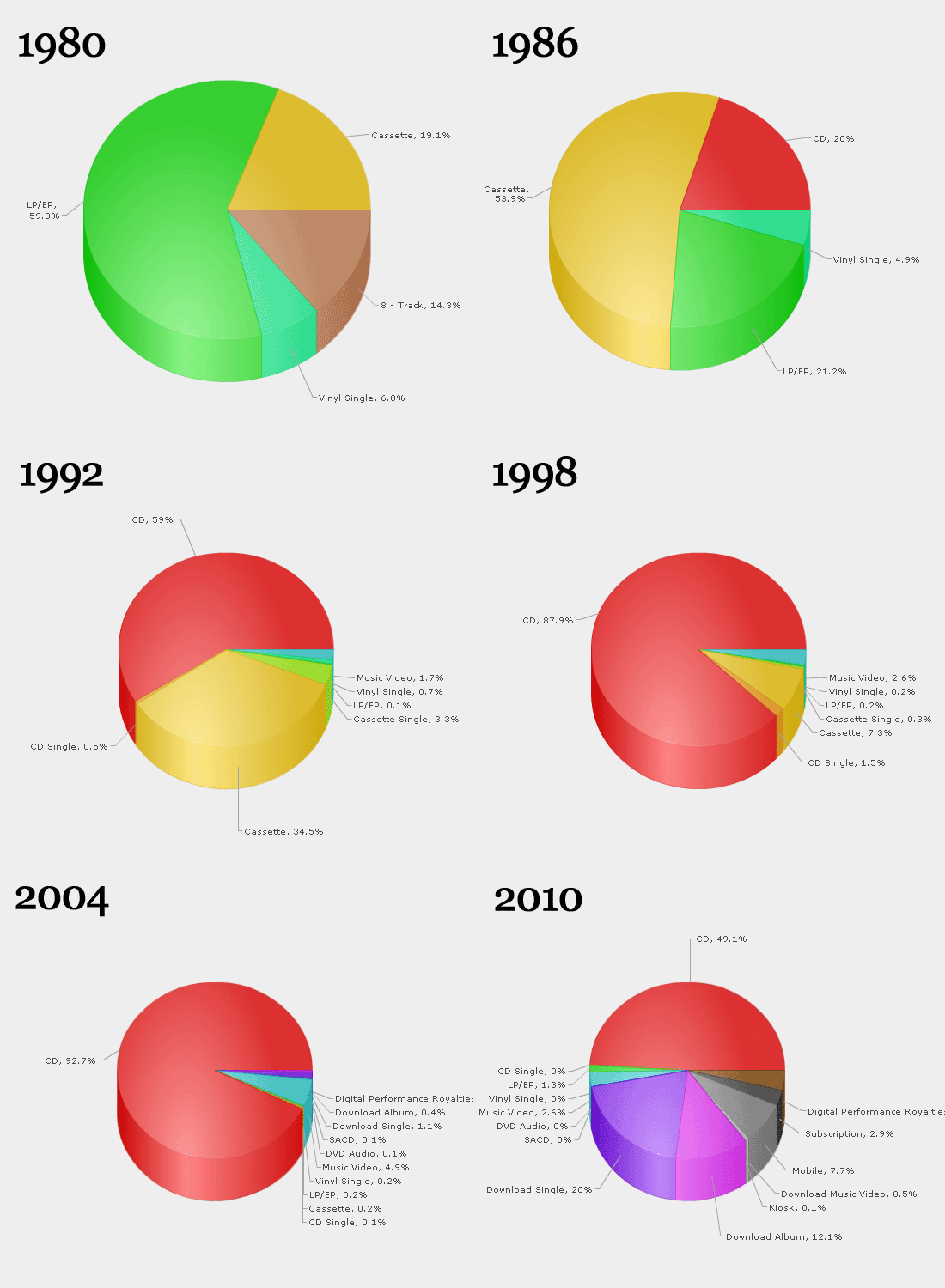
A history of the music industry: from vinyl to download

What I see when I get a moment to pause and make a little sense of the world
Bosses may have it all wrong when they assume that funny cat videos and FAIL slideshows are a drain on the workplace. Some new research finds that a moderate amount of mindless web surfing actually makes workers more productive at their jobs. And the more mindless the surfing, the better.“Employees who browse the web more end up being more engaged at work, so why fight that if it’s in moderation?” says Don J.Q. Chen, a researcher at the National University of Singapore and a co-author of the new report, presented Tuesday at the annual meeting of the Academy of Management.
Although personal web browsing is generally seen as a workplace problem, Chen and his colleague, Vivien K. G. Lim, set out to determine if so-called “cyberloafing” had any benefits. They found that not only did it refresh workers after long work stretches, it made workers more productive than if they’d been given time to talk or text with friends or send personal emails.
via HuffingtonPost


A lot of fearmongering in the media has Americans concerned that all our goods are imported from China. But is that really true? GOOD’s new business editor, Tim Fernholz, calls bullshit:
While Chinese goods seem ubiquitous, especially given America’s economic woes, the reality is that imports from the country are a relatively small part of the economy: A total of 88.5 percent of consumer spending in the United States is on items made here, with only 2.7 percent spent on “Made in China” goods, according to new research from the Federal Reserve Bank of San Francisco:
Gabe Lyons begins his new book, Next Christians: The Good News About the End of Christian America (2010), with the startling confession that several years ago that he was “embarrassed to call myself Christian” (3). He and Dave Kinneman described the source of this embarrassment in their groundbreaking book UnChristian: What a New Generation Thinks About Christianity (2007). Next Christians is Lyons attempt to offer a compelling vision for how the church can reform itself as it learns from the next generations of Christians. This book seeks to answer three questions that Lyons has been chewing on in subsequent years: what does mission look like in America in the twenty-first century, how should the message of the Gospel go forward, and what does it mean to be a Christian in a world disenchanted with our movement (4)?
Continue reading “This Easter join a spiritual adventure with Gabe Lyons and the NEXT CHRISTIANS.”
LOVES WINS: A Book About Heaven, Hell, and the Fate of Every Person Who Ever Lived, a book by Rob Bell, releases today. I am reading it now on my Kindle.
Fragility and the Evolution of Our Humanity
October 7, 2010Xavier Le Pichon is one of the world’s leading geophysicists, and his pioneering research on plate tectonics revolutionized our understanding of how the Earth works. He has also spent decades living in community with people and families facing disability and has emerged with a rare perspective on the meaning of humanity — a perspective equally informed by his scientific and personal encounters with fragility as a fundament of vital, evolving systems.
From Le Pichon conversations we should pay attention to the how materials closer to the core of the earth deform and slide along each other easily. On the other hand, material at the crust is cooler and often only move violently. This is a great metaphor for talking about organizational change. When we are close to the core (vision and mission) change is made easier by our warmth of purpose. When systems become cooler (and the way we have always done it) then the change may be violent and revolutionary.
Ms. Tippett: I think that also you draw analogies between how a whole community works, which is incorporating that fragility as part of its living being and even what you know about how the earth works.
Mr. Le Pichon: Yeah. It’s true that I was very, very impressed by one of these things, which is the way earthquakes are fabricated, which is in the lower layer of the earth where the temperature is high. Then the defaults that are within the rocks are activated, and the rocks are able to deform without fracture, become what we call ductile. You know, they flow.
Ms. Tippett: Right.
Mr. Le Pichon: But when the temperature is low and cold — it’s cold like in the upper few miles of the earth — then they are rigid. These weaknesses cannot be expressed, and as a result the rocks are much resistant, much more rigid, and they react by reaching their limit of resistance and suddenly, bing, you have a major commotion and an earthquake.
Ms. Tippett: Right.
Mr. Le Pichon: And so the difference is that in one case, the defaults play a role in putting weakness in that and making things much more smooth, you know?
Ms. Tippett: Mm-hmm.
Mr. Le Pichon: And in the other case, it’s very rigid. And I find in the society it’s very often the same thing in the community. Communities which are very strong, very rigid, that do not take into account the weak points of the community, the people who are in difficulty and so on, tends to be communities that do not evolve. And when they evolve, it’s generally by a very strong commotion, a revolution, I would call them in French.
 Front Porch Reflections
You must be logged in to post a comment.