Seth Godin asks about our priority list … where did I put it?

Seth always asks the right question! First he asks about our priorities and “what should you do next?” and he provides the answer. Most of us do not know! He adds that we are not alone:

Is it better to email an existing customer, send a brochure to a prospect or improve your product a bit? Should you tweet or post a new blog post? Should you have a meeting to coordinate your team or spend ten minutes returning phone calls instead? This is an unheralded skill, something successful people do really well and others struggle with.

Then he lets us off the hook while he wanders into our lack of priorities on being green:

One of the challenges we have in reducing carbon emissions is that (as far as I know) there’s no priority list. Which is worse: leaving your computer on all night or not having the windows weatherstripped? Which is worse: driving a car to Boston or going by plane with 200 other people? Is it worth driving across town to buy a pint of organic strawberries or should I get the ones from the nearby store that came from California? If you have a thousand dollars to invest in making a reduction in greenhouse gasses, should you buy new tires, switch to local foods or perhaps send $900 to help a factory in China switch away from coal and then use the other hundred to have a massage? Without a list, you can see how making intelligent decisions is impossible, so we resort to confusing activity with productivity.

Don’t worry, Seth still knows how to ask the right question.

Back to your office: do you have a list? Have you figured out which metric you’re trying to improve? Can you measure the impact of the choices you make all day? I see this mistake in business development all the time. Assume for a moment that the goal of someone in this department is to maximize profit. Why then would this group spend most of its time tweaking existing deals (looking for a 3% improvement in yield) instead of spending the same time and effort doing new, game-changing deals?

So many times in my life people want me to spend time doing the 3% thing when a bigger task looms. What will you do when the overwhelming inertia of the trivial blinds you to what you are being called to do for the greater good? I am praying for you to know how to do the right and first thing.
Customer Service — How Much Is Enough?

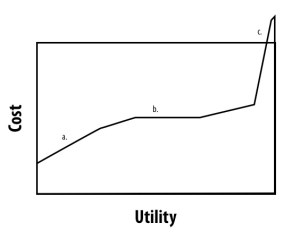
Seth Godin challenges me on a regular basis with his leadership and communicating advice. His simple piece, Spare No Expense!, actually is a piece challenging folks to consider sparing some expense on customer service. Consider the following graph:

costs -vs- # customers served

Seth describes the graph this way:

    In the chart, for example, (a) represents the cost of good signage at the airport, or clearly written directions on the prescription bottle or a bit of training for your staff. It pays off. Pay a little bit and you help a lot of people to avoid hassles. The utility per person isn’t huge, but you can help a lot of people at once.
    (b) is the higher cost of a bit of direct intervention. This is the cost of a call center or a toll free number or an information desk. You’re paying more, you’re helping fewer people, but you’re helping them a lot.
    (c) is where it gets nuts. (c) is where we are expected to spare no expense, where the CEO has to get involved because it’s a journalist who’s upset, or where we’re busy airlifting a new unit out to a super angry customer. The cost is very high, the systems fall apart and only one person benefits.

Here is where it gets tricky. The “spare no expense” desperate attempt to satisfy one can kill the whole enterprise. We often think that if we “spare no expense” we can make a problem or a problem customer go away. And here’s the killer, once we have done this for one person we have set a standard that now must be met for all customers. Organizations need to think this one through. Seth suggests we learn to say internally, “we need to be disciplined and help more people, even if that means that some special cases will fall through the cracks.” It hurts when some people walk away disappointed, but “spare no expense” may ultimately mean destruction.

Seth Godin on why there are not more leaders

In Seth Godin’s recent book Tribes (2008) he notes the following reasons that there seem to be few leaders in the workplace. Read this snippet:

Leadership is scarce because few people are willing to go through the discomfort required to lead.

The scarcity makes leadership valuable. If everyone tries to lead all the time, not much happens. It’s discomfort that creates the leverage that makes leadership worthwhile.

In other words, if everyone could do it, they would, and it wouldn’t be worth much.

It’s uncomfortable to stand up in front of strangers.
It’s uncomfortable to propose an idea that might fail.
It’s uncomfortable to challenge the status quo.
It’s uncomfortable to resist the urge to settle.

When you identify the discomfort, you’ve found the place where a leader is needed.

If you’re not uncomfortable in your work as a leader, it’s almost certain you’re not reaching your potential as a leader.

Some of this sounds like Adam Hamilton’s recent description of “leadership by nausea.” That is, if the decision you are making as a leader makes you ill, you are probably on the right track!