
This is the question I was recently asked. My first response was to wonder why these churches are declining, and perhaps it’s a different reason for each church. The reason for decline, if known, will influence which books would help. Leadership and vision are typically the biggest issue for churches facing decline. Churches need hope that God can use them to make a difference and guidance on how he might lead them to find a new future focused on a clear mission.
I don’t want to overlook the Bible as the foundational answer to understanding church growth and decline. Beyond that I couldn’t narrow to 2-3 books, as requested. Here’s my working list. What titles would you add? Which one would you say is the best or most helpful?
Ed Stetzer and Mike Dodson , Comeback Churches (2007)
Ed Stetzer is director of LifeWay Research and missiologist in residence at LifeWay Christian Resources in Nashville, Tennessee. He holds two masters and doctoral degrees and has written dozens of respected articles and books including Planting Missional Churches, Breaking the Missional Code, Compelled by Love, and Comeback Churches.
Mike Dodson has served as a pastor and church planter strategist in the Northeast for over 15 years. Mike co-authored Comeback Churches with Ed Stetzer and has also published or edited numerous other books and articles. Mike is the Associate Director of North American Church Planting and Assistant Professor of Church Planting and Evangelism at the Southeastern Baptist Theological Seminary in Wake Forest, North Carolina.
Mike Bonem, Leading Congregational Change (2000)
Mike Bonem is president of Kingdom Transformation Partners and author of Leading Congregational Change: A Practical Guide for the Transformational Journey and Leading from the Second Chair: Serving Your Church, Fulfilling Your Role, and Realizing Your Dreams. Mike’s work focuses primarily on the facilitation of healthy change, congregational assessment, vision discernment, and implementation planning. He has created and led seminars for The Purpose-Driven Church, Willow Creek Association, Leadership Network, Citireach International, and other organizations.
Gene Wood, Leading Turnaround Churches (2001)
Gene Wood has served as Senior Pastor at Grace Church of Glendora since January 1991. He is the author of a nine-week discipleship series Advancing Your Faith, and two ”turnaround books”: Leading Turnaround Churches and Leading Turnaround Teams . These books, along with Leading Turnaround Training Seminars, are being used to strengthen and mobilize churches throughout the United States and abroad.
Ron Crandall, Turnaround Strategies for the Small Church (1995)
Ron Crandall is the McCreless Professor of Evangelism in the E. Stanley Jones School of World Mission and Evangelism, Asbury Theological Seminary, Wilmore, Kentucky. Previously, he worked with small churches as evangelism director for the General Board of Discipleship, United Methodist Church. He sings in the Lexington, Kentucky, Community Chorus and was the president of the Academy for Evangelism in Theological Education. He is the author of WITNESS: Exploring and Sharing Your Christian Faith, a 25-week small group resource.
George Barna, Turnaround Churches (1993)
Born in New York City, George Barna worked in the Massachusetts state legislature and as a pollster and a campaign manager. Introduced to Jesus Christ during his grad school years, he moved to California, where he worked in media research and then as an executive in an advertising agency. In 2004, he re-engineered the for-profit corporation into The Barna Group, of which he is the Directing Leader. To date, Barna has written more than 35 books, predominantly in the areas of leadership, trends, spiritual development, and church health. Included among them are best sellers such as Revolution, Transforming Children into Spiritual Champions,The Frog in the Kettle, The Power of Vision, and User Friendly Churches.
Larry Osborne, Sticky Church (2008)
Larry Osborne has served as a Senior Pastor and Teaching Pastor at North Coast Church since 1980. He has helped oversee the growth of the church from a fledgling group of 128 meeting in a rented school, to a multi-site ministry that reaches nearly 7,000 in weekend attendance. Larry is also an author and a nationally recognized trainer of pastors. His books include 10 Dumb Things Smart Christians Believe, Spirituality for the Rest of Us and THE Unity Factor: Developing A Healthy Leadership Team. He travels extensively speaking at conferences and mentoring pastors and church planters across the country.
Brad Powell, Change your Church for Good:The Art of Sacred Cow Tipping (2007)
For the last nineteen years Brad has been the Senior Pastor here at NorthRidge Church in Plymouth, Michigan, previously known as Temple Baptist of Detroit. Brad is a frequent conference speaker; author of Change your Church for Good, Revised, regular columnist for Outreach Magazine; recently named contributing editor of the Leadership Journal; and host of and primary teacher for an annual conference called “Change Without Compromise.”
Dave Browning, Deliberate Simplicity (2009)
Dave Browning is a visionary minimalist and the founder of Christ the King Community Church, International (CTK). CTK is a non-denominational, multi-location church that has been noted as one of the “fastest growing” and “most innovative” churches in America by employing the K.I.S.S method: “keep it simple and scalable.”Prior to CTK, Dave pastored in traditional and mega-church contexts. His experiences led him to become a pastorpreneur and to break many of the rules of the established church, including “bigger is better.” A scion of simplicity, Dave coined the phrase “deliberate simplicity” to describe a new equation for church development, where less is more, and more is better.
Jim Collins, How the Mighty Fall (2009)
Jim Collins is a student of companies–great ones, good ones, weak ones, failed ones–from young start-ups to venerable sesquicentenarians. The author of the national bestseller Good to Great and coauthor of Built to Last, he serves as a teacher to leaders throughout the corporate and social sectors. His work has been featured in Fortune, BusinessWeek, The Economist, USA Today, and Harvard Business Review. Jim has served as a teacher to senior executives and CEOs at over a hundred corporations. He has also worked with social sector organizations, such as: Johns Hopkins Medical School, the Girl Scouts of the USA, the Leadership Network of Churches, the American Association of K-12 School Superintendents, and the United States Marine Corps. In 2005 he published a monograph: Good to Great and the Social Sectors.
Eric Geiger and Thom Rainer, Simple Church (2006)
Thom S. Rainer is president and CEO of LifeWay Christian Resources in Nashville, Tennessee. He was founding dean of the Billy Graham School of Missions, Evangelism and, Church Growth at The Southern Baptist Theological Seminary. He is also a best-selling author and leading expert in the field of church research. His many books include Surprising Insights from the Unchurched, The Unexpected Journey, and Breakout Churches.
Eric Geiger serves as executive pastor of Christ Fellowship, a large and growing multicultural church comprised of more than seventy nationalities near Miami, Florida. Eric frequently consults with and speaks to church leaders. He is the author/co-author of Simple Student Ministry. He received a doctorate in leadership and church ministry from Southern Seminary in Louisville, Kentucky.
Warren Bird, Ph.D., is Research Director at Leadership Network, and co-author of 21 books on various aspects of church health and innovation. His recent “Leadership Network” books blogs include He Irritates Christians to Get Busy and Change the World, Becoming a Healthy Fruitful Multi-Ethnic Church, What Is Necessary for Church Planting to Go Viral?Mark Batterson’s Primal, Updated Publishing Updates, Beyond Christendom Says Migration Keeps Transforming the Church, Terrific Biography of Rick Warren, The Soviet Plot to Kill God, The Worst Moment in Most Church Services, Excellent Resources for Church-Based Grants, Multi-Site Church Roadtrip Released Today, Do White Churches Hold Others in Cultural Captivity?and Church Merger Phenomenon Continues to Expand.
Category: Practices
Bill Easum interviews Frank Viola about Jesus Manifesto (via books@ leadership network)
Bill Easum Interviews Frank Viola on the new book JESUS MANFIESTO
I had a chance to chat with Frank Viola recently. You may recall, Frank has published some cutting edge books lately. Then along came Jesus Manifesto coauthored with Len Sweet, a long time friend. When I asked Frank if he would talk with me about the book, he was gracious to talk to me. Here are the results of our conversation.
Frank, it’s good to have you do this interview. I know our readers are to benefit greatly. What motivated you both to write this book?

For years, Len and I both shared a burden and concern that Jesus has been getting short-changed in many quarters of His church. In our observation, scores of Christians are excited about and majoring in things that are about Jesus, while Christ Himself is getting left out in the cold.
It appears that there’s a segment of the Christian church that wants to be the hands and feet of Jesus, while detaching themselves from the Head. Others want to bring attention to the work of Christ in the past, but don’t care too much about seeking His face or living by His Risen life in the present.
So we felt to do a project together that would not only give Christ His rightful place . . . that would not only exalt Him beyond the exosphere . . . but that would also unveil His breathtaking Person in ways that would re-introduce Him in a powerfully fresh way to many of God’s people, leaving them staggering to hunger and thirst for Him and Him alone. Our book seeks to bring together the atoning work of Jesus, the teachings of Jesus, and the Person of Christ into one enormous whole in the context of knowing Christ as our indwelling Lord as Galatians 2:20, Colossians 2, and Romans 8 vividly describe.
Let me give you an example of how deep the problem runs. Take for instance the four Gospels. A question sometimes asked is “What are the main themes of the four Gospels?” And so people will begin counting words and underling terms. “The Kingdom of God” is a popular answer. “Eternal Life” is another. “Salvation” another. But the governing theme of all four Gospels is none of the above. In fact, it’s as plain as the nose on an Italian’s face, yet we routinely and frequently miss it. (I’m Italian by the way 😉
The theme is JESUS CHRIST.
What are the four Gospels? Among other things, they are the content of what Twelve men who lived with God in human form for a little over 3 years presented to a new group of Christians beginning on the day of Pentecost in the city of Jerusalem. They preached Christ to those new believers for about four years. They told the stories of what it was like to live with Him. What He said, did, taught, etc.
The first church on earth was built on a revelation of Jesus Christ. And that revelation is partly contained in the four Gospels. Yet we very rarely hear the four Gospels described in this way.
Let me go a little further. One of the things that has fascinated me as a Christian is the fact that Paul of Tarsus would spend several months with a new church plant in heathen soil, and then return after a year to find them still gathering under Christ and following Him. In fact, last year, I wrote an entire book about this very subject. The question before the house for me was: “What on earth did Paul preach to those people in the space of a few months to cause that kind of dynamic and sustaining effect?” Remember, that was a day in which there was no NT available, the OT scrolls were scarce and locked up in the synagogues, and 90% of those new Christians were illiterate.
Right or wrong, I believe that some of what we have presented in Jesus Manifesto gets close to what Paul preached. He called it “the unsearchable riches of Christ” in Ephesians – something we don’t hear too often today. We feel (and hope) that Jesus Manifesto gives readers a glimpse of some of those riches.
How to Stay Positive
via youtube.com
Control Your Facebook Privacy
I have been adjusting my presence on Facebook on a continuing basis. Now may be a time for you to adjust your privacy as well.
The Barna Group says Americans feel connected to Jesus, but the younger you are the further away your feel.
The Barna Group always offers an interesting take on the cultural views of Americans. I am not surprised to see that women, Protestants, and social conservatives are more likely than men, Catholics, and social liberals to talk about a personal relationship with Jesus. It is very interesting to see one more piece talking about the decline of a personal faith among the next generation (see David Kinnaman’s and Gabe Lyons’ work unCHRISTIAN). What other surprises do you see in this article?
In the age of Facebook, Twitter, and texting, many Americans feel more connected to people than ever, but a new national survey by The Barna Group shows that Americans are not just connected to each other. One of the dominant connections in people’s lives is with Jesus Christ. In fact, more people claim to be closely connected to Jesus Christ than have a Facebook page or Twitter account.
Close Relationship
The Barna study, conducted among a random sample of 1,002 U.S. adults, discovered that two out of every three adults (67%) claimed to have a “personal relationship” with Jesus that is currently active and that influences their life.
While a majority of most demographic segments said they had such an active and personal relationship with Jesus, some segments were more likely than others to claim such a connection. For instance, women (72%) were more likely than men (62%) to do so. Protestants were more likely than Catholics to cite such a relationship (82% versus 72%). People who describe themselves as mostly conservative on social and political matters were far more likely than those who see themselves as liberal on such issues to connect with Jesus (79% compared to 48%). And one of the most instructive findings was that the younger a person was, the less likely they were to claim to have an active and influential bond with Jesus. Specifically, while 72% of adults 65 or older and 70% of Boomers (i.e., ages 46 to 64) had such a relationship in place, 65% of Busters (i.e., ages 27 to 45) and only 52% of Mosaics (ages 18 to 26) did, as well.
via barna.org
58% of Americans pray every day. Your faith tradition, gender, age and income reflects you tendency to join in prayer.

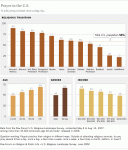
Seth Godin challenges us to expose ourselves … its not what you are thinking.
Expose yourself…
With so many options in media, interaction and venues, you now get to choose what you expose yourself to.
Expose yourself to art, and you’ll come to appreciate it and aspire to make it.
Expose yourself to anonymous scathing critics and you will begin to believe them (or flinch in anticipation of their next appearance.)
Expose yourself to get-rich-quick stories and you’ll want to become one.
Expose yourself to fast food ads and you’ll crave french fries.
Expose yourself to angry mobs of uninformed, easily manipulated protesters and you’ll want to join a mob.
Expose yourself to metrics about your brand or business or performance and you’ll work to improve them.
Expose yourself to anger and you might get angry too.
Expose yourself to people making smart decisions and you’ll probably learn how to do it as well.
Expose yourself to eager long-term investors (of every kind) and you’ll likely to start making what they want to support.
It’s a choice if you want it to be.
The Freakonomics guys ask “what would your if you knew you were going to die?”
What Would You Say If You Knew You Were Going to Die?
Here’s an interesting-but-disturbing story from the Freakonomics blog. A study of the last statements offered by several death-row inmates found that 36 percent admitted responsibility, and 32 percent expressed sorrow or sought forgiveness from family members impacted by the inmate’s crime. As the author of the piece points out, “what’s really interesting is how the content of final statements changed after Texas, on January 12, 1996, began allowing family and friends of homicide victims to attend executions.” Knowing they had to face the ones they wronged, dramatically increased the number of confessions and petitions for forgiveness on the part of the inmates.
Howard Thurman reminds us that Christ belongs in every season via God’s Politics Blog
When the song of the angels is stilled,
when the star in the sky is gone,
when the kings and princes are home,
when the shepherds are back with their flock,
the work of Christmas begins:
to find the lost,
to heal the broken,
to feed the hungry,
to release the prisoner,
to rebuild the nations,
to bring peace …
to make music in the heart.
– Howard Thurman
American author, civil rights leader, and theologian (1899-1981)
via Voice of the Day: Howard Thurman – God’s Politics Editor – God’s Politics Blog.
The Barna Group offers a Year-in-Review Perspective
The Barna Group – Barna Studies the Research, Offers a Year-in-Review Perspective.
Four major themes are addressed in the above end of year review:
- Theme 1: Increasingly, Americans are more interested in faith and spirituality than in Christianity.
“One of those assumptions relates to how we develop our faith. These days,” he continued, “the faith arena is a marketplace from which we get ideas, beliefs, relationships, habits, rituals and traditions that make immediate sense to us, and with which we are comfortable. The notion of associating with a particular faith – whether it is Christianity, Judaism, Islam, or some other strain – still has appeal because that connection provides a discernible identity and facilitates the possibility of belonging to something meaningful. But the actual components of what we choose to belong to are driven by our momentary needs and perceptions.
- Theme 2: Faith in the American context is now individual and customized. Americans are comfortable with an altered spiritual experience as long as they can participate in the shaping of that faith experience.
“Now that we are comfortable with the idea of being spiritual as opposed to devoutly Christian,” Barna pointed out, “Americans typically draw from a broad treasury of moral, spiritual and ethical sources of thought to concoct a uniquely personal brand of faith. Feeling freed from the boundaries established by the Christian faith, and immersed in a postmodern society which revels in participation, personal expression, satisfying relationships, and authentic experiences, we become our own unchallenged spiritual authorities, defining truth and reality as we see fit.
- Theme 3: Biblical literacy is neither a current reality nor a goal in the U.S.
“Bible reading has become the religious equivalent of sound-bite journalism. When people read from the Bible they typically open it, read a brief passage without much regard for the context, and consider the primary thought or feeling that the passage provided. If they are comfortable with it, they accept it; otherwise, they deem it interesting but irrelevant to their life, and move on. There is shockingly little growth evident in people’s understanding of the fundamental themes of the scriptures and amazingly little interest in deepening their knowledge and application of biblical principles.
- Theme 4: Effective and periodic measurement of spirituality – conducted personally or through a church – is not common at this time and it is not likely to become common in the near future.
“It may well be that spiritual evaluation is so uncommon because people fear that the results might suggest the need for different growth strategies or for more aggressive engagement in the growth process. No matter what the underlying reason is, the bottom line among both the clergy and laity was indifference toward their acknowledged lack of evaluation. That suggests there is not likely to be much change in this dimension in the immediate future. In other words, as we examine the discipleship landscape, what we see is what we get – and what we will keep getting for some time.”
 Front Porch Reflections
You must be logged in to post a comment.